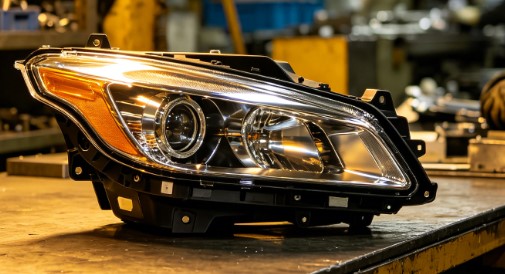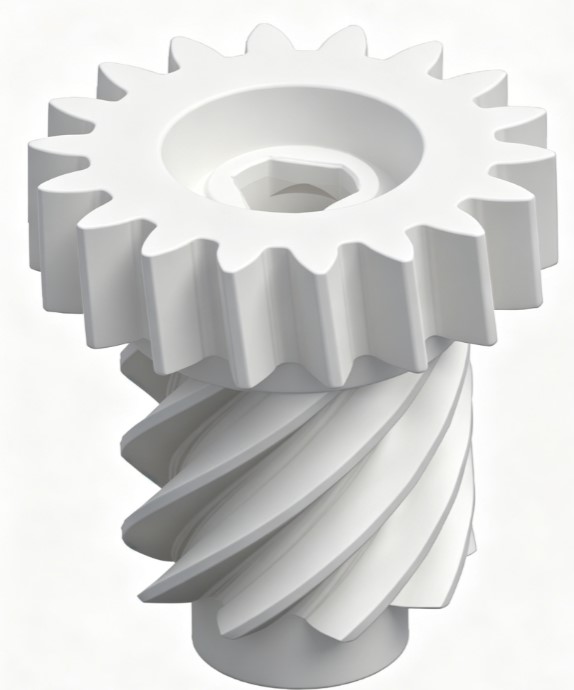
Semi-solid Magnesium Alloy AZ91D forming
| Information | |
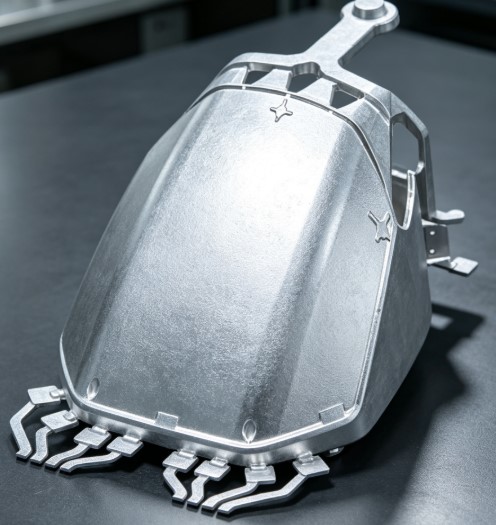
| Industry | Chassis brackets, seat frames, battery pack housings, steering components |
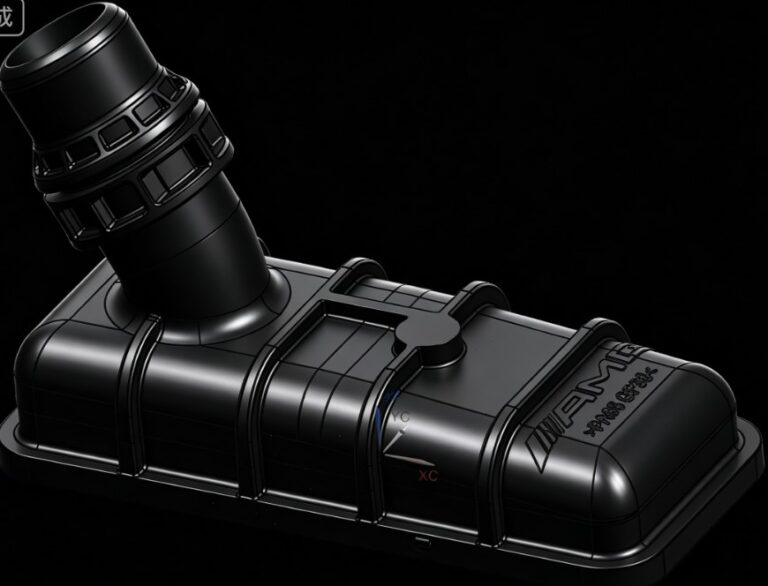
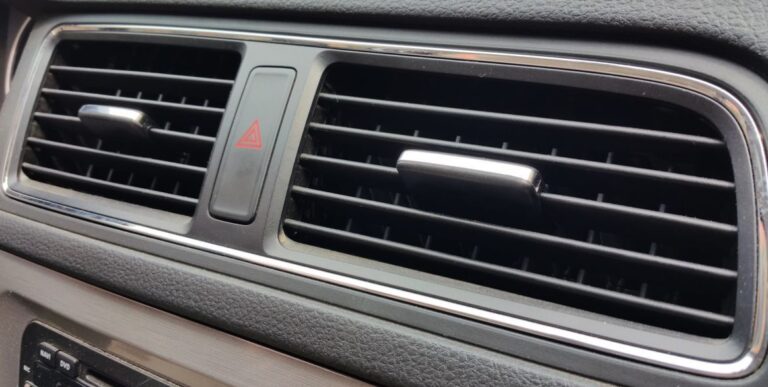
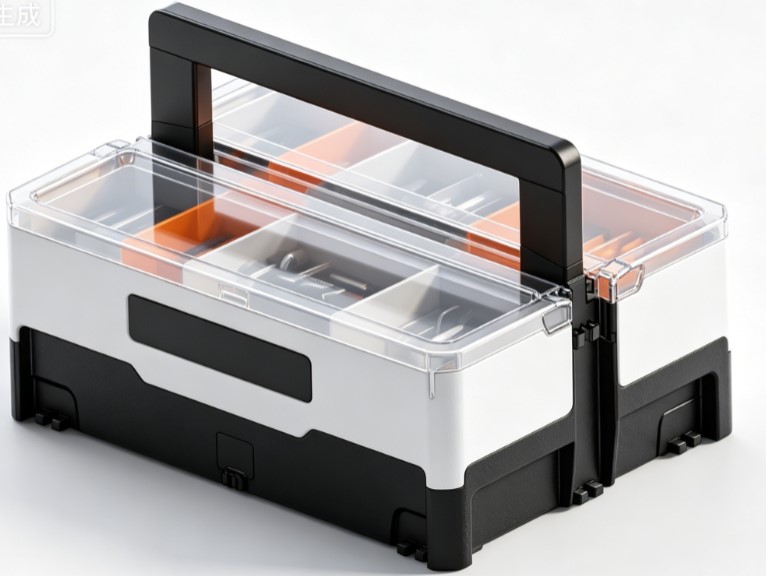
| Product | frames |
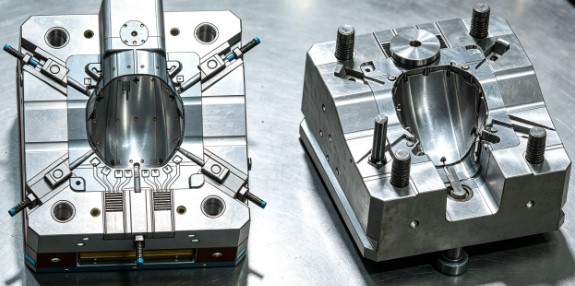
| Challenges | Extremely strict precision requirement,moldlife:100000shots |
| Technology | Semi-solid magnesium alloy forming |
| Surface Finish | SPI B2 |
| Material | AZ91D ,Steel is RDC-EC |
| Cavities | 1*1 |
| Mold size | 830X850X820 mm |
Products Introduction
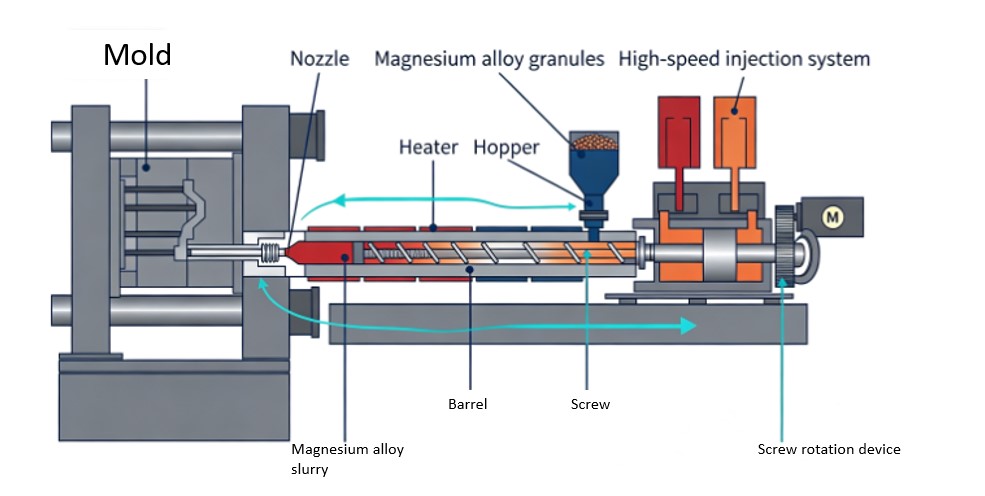
- A forming process: heat magnesium alloy into the solid-liquid two-phase region. Shear or agitation breaks dendritic crystals to obtain slurry where spherical solid particles are suspended in liquid phase, followed by high-pressure cavity filling for forming. Common base materials: AZ91D, AM60, AZ31 and other commercial magnesium alloys.
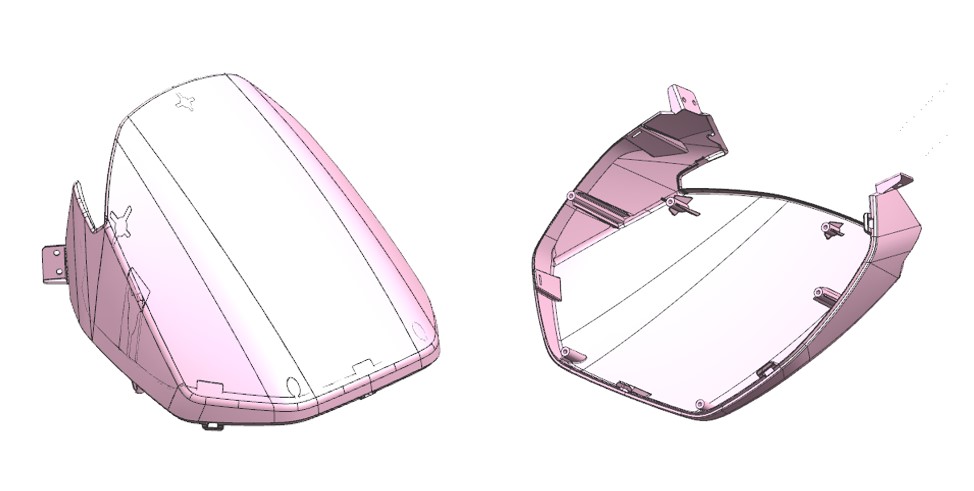
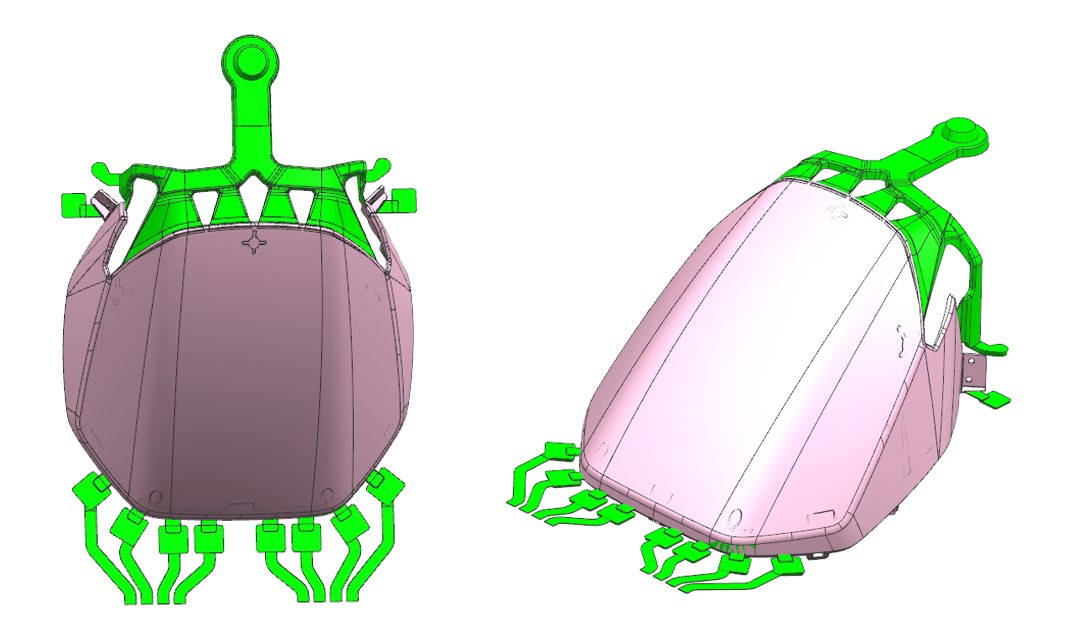
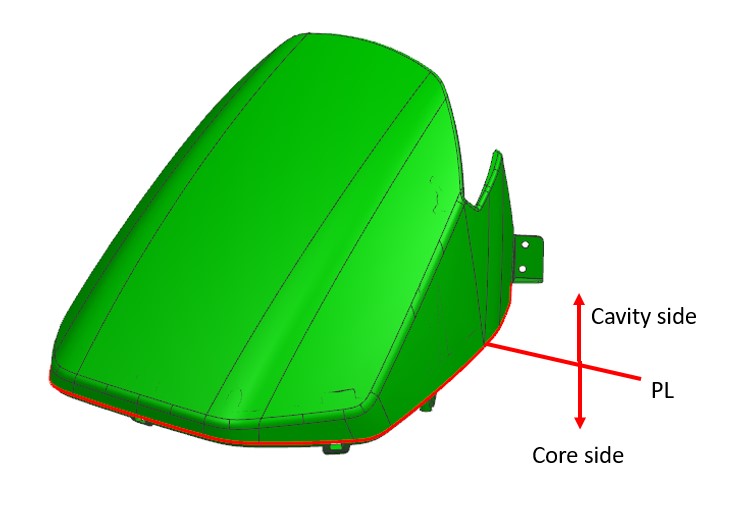
DFM Analysis
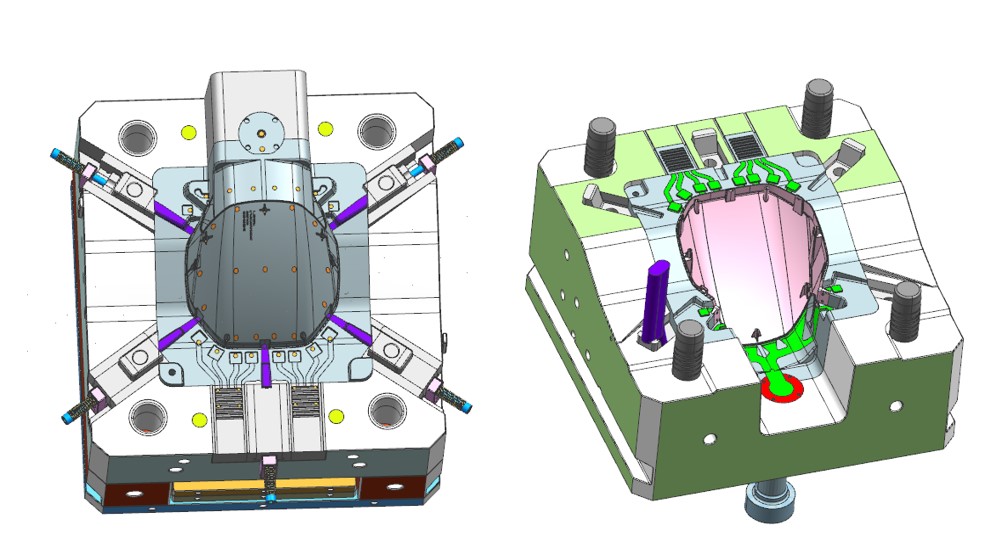
Mold design
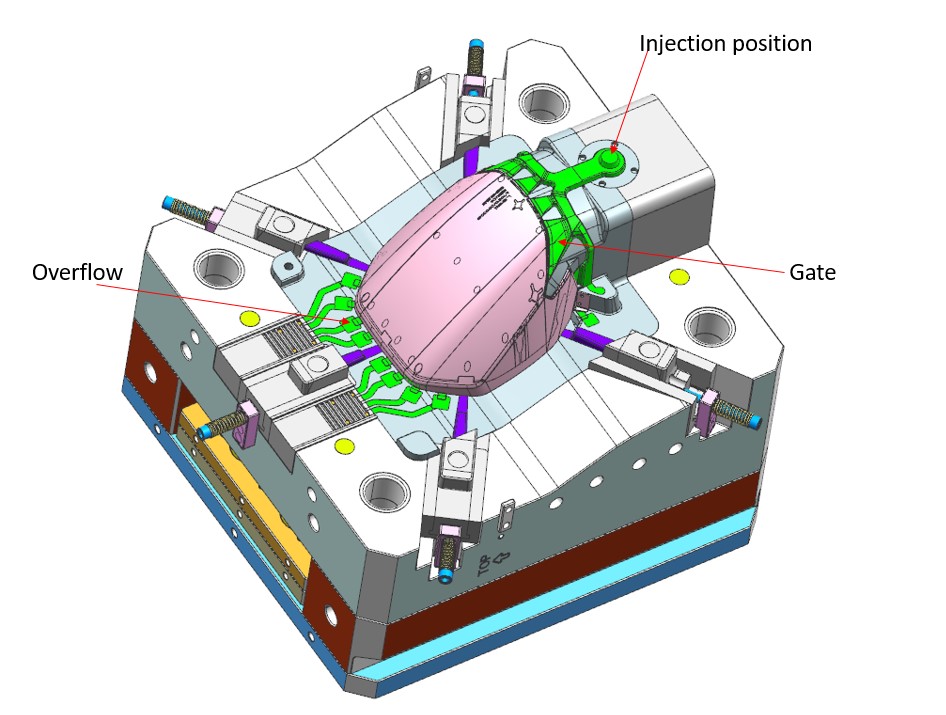
Key Advantages
- Low porosity, high density: Density up to 99.5%+, porosity <1%. Heat treatment strengthening is available, greatly improved mechanical properties, applicable for load-bearing structural components. Conventional die castings contain abundant pores and cannot be heat-treated.
- Lower forming temperature: Reduced thermal shock to molds, significantly extended mold life (100,000–200,000 shots).
- Environmental friendly & safe: Closed forming, magnesium melt is not exposed. SF₆ shielding gas is not required (potent greenhouse gas), lower risk of combustion and explosion, reduced energy consumption and carbon emission.
- Near-net-shape forming: Capable of thin-wall complex parts, good dimensional accuracy, higher material utilization (≥70%) and less post-machining.
- Uniform microstructure: Fine spherical grains, small batch-to-batch property variation and better fatigue performance.
- Minimum wall thickness for semi-solid magnesium alloy (Thixomolding):
- Mass production stable: 0.5~0.6 mm
- Prototype / extreme trial: 0.3~0.45 mm (low yield, limited filling length)
- DFM recommended design: ≥0.8~1.0 mm
Key constraints: flow length to thickness ratio, solid fraction, mold temperature, gate & vent layout, high-speed injection capability.
Mold temperature range for semi-solid magnesium alloy (Thixomolding, AZ91D):
- General mass production: 260℃ ~ 300℃
- Thin-wall parts (0.5~0.8 mm): 290℃ ~ 320℃
- Thick-wall parts (>1.5 mm): 240℃ ~ 270℃
Key notes:
- Mold needs built-in heating system, temperature tolerance ±5℃.
- Preheat mold fully before trial.
- Unlike conventional magnesium die casting, the mold is mainly heated; only hot spots apply localized cooling.
Brief Comparison (Conventional Mg Die Casting vs Semi-solid Mg)
| Item | Conventional Magnesium High-Pressure Die Casting | Semi-solid Magnesium Forming |
| Forming Temperature | ~650–680℃ | 580–610℃ |
| Filling Pattern | Turbulent flow, prone to gas entrapment | Laminar flow, low gas entrapment |
| Heat Treatment | Not feasible (blistering due to pores) | T5/T6 heat treatment available |
| Mold Life | Relatively low | Greatly improved |
| Shielding Gas | SF₆ required | Most cases not required |
| Applicable Parts | Cosmetic parts, non-load-bearing parts | Load-bearing structural parts |
Recommended Mold Trial Sequence
- Dry raw material, preheat barrel, stabilize slurry solid fraction (solid fraction is the key parameter for semi-solid forming)
- Low pressure & low speed filling test, check material flow and vent performance
- Gradually increase injection & packing pressure to resolve short shot and shrinkage defects
- Optimize cooling and ejection parameters to improve warpage and cracking
| No. | Defect | Root Cause | Countermeasure |
| 1 | Short shot | 1. High solid fraction / low slurry temperature, poor fluidity2. Insufficient injection pressure & packing pressure3. Small gate size / blocked venting4. Low mold temperature, premature solidification of slurry front | 1. Slightly raise barrel temperature to reduce solid fraction2. Increase injection pressure & set multi-stage injection speed3. Enlarge gate, add overflow wells and widen vents4. Raise mold preheating temperature to keep uniform cavity surface temp |
| 2 | Cold shut / Weld line | 1. Low temperature when two slurry fronts merge, poor fusion2. Semi-solid slurry has weaker welding capacity than liquid metal3. Multiple gates causing material convergence | 1. Increase slurry & mold temperature2. Optimize gate location to minimize material convergence3. Raise injection speed to shorten filling time4. Add overflow wells at weld line to discharge low-temperature front material |
| 3 | Porosity / Gas entrapment | 1. Insufficient or blocked vents, trapped air in cavity2. Moist magnesium granules generating gas3. Turbulent flow at high speed leading to air entrapment | 1. Clean vents, add vent quantity or vacuum venting2. Dry raw granules and keep hopper moisture-proof3. Reduce high-stage injection speed to maintain laminar filling4. Use overflow wells to guide gas out |
| 4 | Shrinkage cavity / Shrinkage porosity | 1. Heavy wall sections / hot spots, no feeding during solidification2. Insufficient packing pressure & short packing time3. Gate solidifies early and closes feeding path | 1. Optimize part geometry, add radius for thickness transition2. Extend packing time and raise packing pressure3. Add local cooling or feeding risers on hot spots4. Adjust gate position to ensure gate solidifies after hot spot |
| 5 | Solid-liquid segregation | 1. High solid fraction, solid particles separate from liquid phase during filling2. Uneven dispersion of solid particles3. Sharp cross-section reduction in runner | 1. Reduce solid fraction by raising slurry temperature moderately2. Optimize screw shearing to uniformly disperse solid particles3. Avoid abrupt narrow runner geometry4. Prevent long low-speed advance of slurry |
| 6 | Flash / Burr | 1. Insufficient clamping force2. Large clearance on parting line, inserts or sliders3. Excessive slurry temperature and high fluidity4. Peak injection pressure opens mold | 1. Increase mold clamping force2. Repair clearance of parting line, sliders and inserts3. Lower slurry temperature to reduce fluidity4. Reduce peak injection pressure to avoid mold opening impact |
| 7 | Warpage & Distortion | 1. Uneven mold cooling, inconsistent shrinkage2. Wall thickness variation creates solidification stress3. Unbalanced ejection force4. Improper packing & cooling time | 1. Optimize cooling channels for uniform mold temperature2. Balance ejector pin layout, avoid concentrated ejection3. Extend cooling time, control ejection temperature4. Adjust packing parameter, stress relief aging if needed |
| 8 | Cracks (Hot / Cold crack)( | Hot crack: Shrinkage stress at sharp corners, hot spots Cold crack: Fast cooling, low ejection temperature, stress concentrationUnbalanced ejection force | 1. Add fillet radius at sharp corners to reduce stress concentration2. Control mold temperature and reduce cooling gradient3. Relocate gate away from hot spots & stress sensitive zones4. Reduce ejection speed and balance ejector force |
| 9 | Oxide inclusion / Slag mark | 1. Magnesium easy to oxidize; oxide film folded into cavity2. Oxide slag accumulated in barrel, screw and runner3. Impurity in raw material | 1. Use clean raw granules2. Regularly clean oxide slag inside barrel, screw and runner3. Use overflow wells to capture oxide dross4. Reduce screw speed to minimize oxidation; apply shielding gas if required |
| 10 | Mold sticking / Scuffing | 1. Poor cavity surface roughness; improper release agent spraying2. Over-high mold temperature causes galling3. Insufficient draft angle, slider clearance problem | 1. Polish cavity surface, check draft angle2. Spray thin & uniform release agent3. Reduce mold temperature appropriately4. Inspect sliders / lifters to avoid undercut sticking |
Post-treatments for Semi-solid Magnesium Alloy Products
Semi-solid magnesium alloy products feature dense matrix with almost no entrapped gas pores, so T4/T6 heat treatment is applicable, which cannot be performed on conventional die-cast magnesium parts.
1. Gating Removal & Cleaning (Primary Post-processing)
- Hydraulic trimming / Punching: Remove runners, biscuit and flash; preferred for mass production.
- Grinding, sanding & polishing: Manual or robotic grinding; rough polishing, fine polishing and mirror polishing (for 3C cosmetic parts).
- Sand blasting / Shot peening: Use #80~#200 glass beads or alumina grit to remove oxide scale, create matte texture and induce mild stress strengthening. Control blasting pressure to avoid surface indentation.
- Degreasing & cleaning: Alkaline cleaning, pickling and ultrasonic cleaning to remove cutting oil and release agent. Mandatory pre-process for all chemical surface treatments.
2. Heat Treatment (Core Advantage of Semi-solid Magnesium Alloy)
Conventional die-cast magnesium parts contain internal gas pores which blister upon heating. Semi-solid material has dense microstructure and supports full solution & aging treatment.
- Stress-relief annealing: Eliminate residual stress from forming and CNC machining to reduce subsequent distortion.
- T4 (Solution treatment + water quenching): Improve ductility and toughness. For AZ91D, typical holding temperature is ~400°C followed by rapid water cooling.
- T5 (Direct aging after forming): No solution treatment. Low-temperature aging to boost hardness and strength with minimal distortion and lower cost.
- T6 (T4 solution treatment + artificial aging): Most common high-strength route, greatly increases tensile and yield strength. Typical aging holding temperature: 160~180°C. Double aging is also available to balance strength and toughness.
- Homogenization annealing: Mitigate microstructure segregation.
3. Surface Anti-corrosion & Functional Coatings
Magnesium alloy substrate is highly susceptible to corrosion.
- Chemical conversion coating (passivation) Chromate-free passivation (mainstream eco-friendly option), zirconium-titanium conversion coating. Thin film, normally used as primer base layer. Poor standalone corrosion resistance, suitable for small 3C components.
- MAO / PEO (Micro Arc Oxidation / Plasma Electrolytic Oxidation, premium option) Forms ceramic hard oxide layer with high hardness, wear resistance, electrical insulation and superior salt spray performance. Widely adopted for automotive, robot and energy storage structural parts. Available in black, grey and natural tones; coating thickness: 5~30 μm.
- Magnesium alloy anodizing: Thicker film than conversion coating for decoration and basic corrosion protection. Porous layer, sealing is generally required.
- Organic coating systems (combined protection)
- E-coat: Uniform film, ideal for complex cavities
- Powder coating, liquid painting (epoxy/PU primer + topcoat). Usually combined with passivation or MAO underlayer to achieve salt spray resistance up to thousands of hours.
- Electroplating / Electroless plating: Electroless nickel plating, zinc displacement pre-treatment. Strict pre-treatment required, applied for electromagnetic shielding and wear-resistant functional parts with relatively high cost.
- Sealing treatment: Seal micropores after MAO / anodizing to enhance corrosion resistance.
4. Precision Machining
- CNC milling, drilling, tapping, diamond tool high-gloss cutting (for 3C housings)
- Grinding, honing (for high-precision assembly bores)
Note: Magnesium chips are flammable during cutting. Optimize cutting parameters, implement dust extraction and use dedicated cutting fluid.
5. Secondary Forming & Assembly Processes
- Overmolding (secondary injection of soft elastomer for handles and sealing parts)
- Welding: FSW (Friction Stir Welding), laser welding. Dense semi-solid substrate delivers better welding yield than die-cast magnesium.
- Riveting, press-fitting, threaded insert pressing
- Laser marking, silk-screen printing, pad printing (marks and logos)
6. Supporting Inspection Procedures
Dimensional inspection, CMM measurement, metallography, SPC dimensional data collection, air tightness test, salt spray test, tensile mechanical test.
Summary
High-speed CNC machining center, deep hole drill, wire EDM, sinker EDM, precision surface grinder, vacuum heat treatment furnace, polishing machine, CMM coordinate measuring machine, Rockwell hardness tester, lathe & milling machine.
Note: Semi-solid molds operate at 240~320℃; high quality hot work steel and precise heating/cooling holes are required.
semi-solid magnesium injection machine (core unit), high-temperature mold temperature controller, preheating & drying hopper for Mg granules, robot part extractor, release agent spraying system, deburring & blasting equipment, dimensional inspection tools. Optional lab equipment: Metallographic equipment, tensile tester, X-ray flaw detector. Safety system: Explosion-proof ventilation & magnesium dust collection system.